


Updated 17 May 2026
On the evening of 19 April 2026, the Undang Yang Empat1 of Negeri Sembilan made a declaration that would have been extraordinary in any era. What made it uniquely 21st century was the medium they chose: Facebook Live.
By the time mainstream media had begun reporting, the declaration had already spread across WhatsApp groups, Twitter threads, TikTok videos, and Instagram stories, reaching hundreds of thousands of Malaysians who would never normally follow the intricacies of state constitutional law.
The Negeri Sembilan royal crisis of 2026 is the first Malaysian royal crisis of the social media age. And it has played out in ways that would have been unimaginable even a decade ago.
How did the story break? On Facebook
On 19 April, the declaration came without warning. Mubarak went live on the official Luak Sungei Ujong Facebook page at around 6:15pm on a Sunday evening, bypassing any prior notice to media or formal institutional channels.
Within hours, the video had been clipped, shared, screenshotted and discussed across every major Malaysian social media platform. By the time the Menteri Besar (MB) issued his response in the early hours of Monday morning, millions of Malaysians already had an opinion.
On 5 May, the Majlis Dato Lembaga Adat Sungei Ujong used Facebook to announce the appointment of Muhammad Faris as the 11th Undang of Sungei Ujong, and a competing faction within the same Majlis used the same platform hours later to circulate six documents declaring that installation invalid.
The Facebook ecosystem has carried voices at very different ends of the spectrum. On one hand, former Deputy Public Prosecutor and Senior Federal Counsel Liyana Marzuki has posted detailed constitutional analysis to a substantial Facebook audience, citing specific articles of the Negeri Sembilan Constitution 1959.
On the other hand, political activists with large followings have used the same platform to make unverified allegations relating to the crisis. These posts can reach tens of thousands of readers within hours.
What this means is that Facebook has become the platform of first record for the crisis, not just for the declaration itself but for the legal commentary, the counter-claims and the rolling political response.
What role did Threads, X and Instagram play?
Threads has emerged as the primary arena for public debate about the crisis. What used to play out on Twitter, the legal explainers, the running commentary, the wordplay, the thread-by-thread analysis, has largely migrated to Threads. Much of the discourse is in Bahasa Melayu.
Several dynamics emerged across both platforms in the days following the declaration:
The legal explainer wave. Within 24 hours, multiple accounts, lawyers, academics, journalists and ordinary Malaysians, had begun posting detailed threads explaining Article 10 of the Negeri Sembilan Constitution 1959, the role of the Ibu Soko, the requirements for a valid proclamation and the history of the 2008 succession. Constitutional law, normally the province of law journals and academic conferences, became viral content.
The meme war. Alongside the serious legal analysis, a parallel war of memes, wordplay and satire erupted. The hashtag #UndangDiSebalikBatu, a play on the Malay idiom “ada udang di sebalik batu” (there’s a prawn behind the rock), swapping “udang” for “Undang”, became one of the most-used hashtags of the crisis. Lego-style infographics explaining constitutional law in simple visual terms attracted hundreds of thousands of views.
Instagram played a smaller but still notable role. Accounts like @satriawiran9 published constitutional infographics that travelled across platforms.
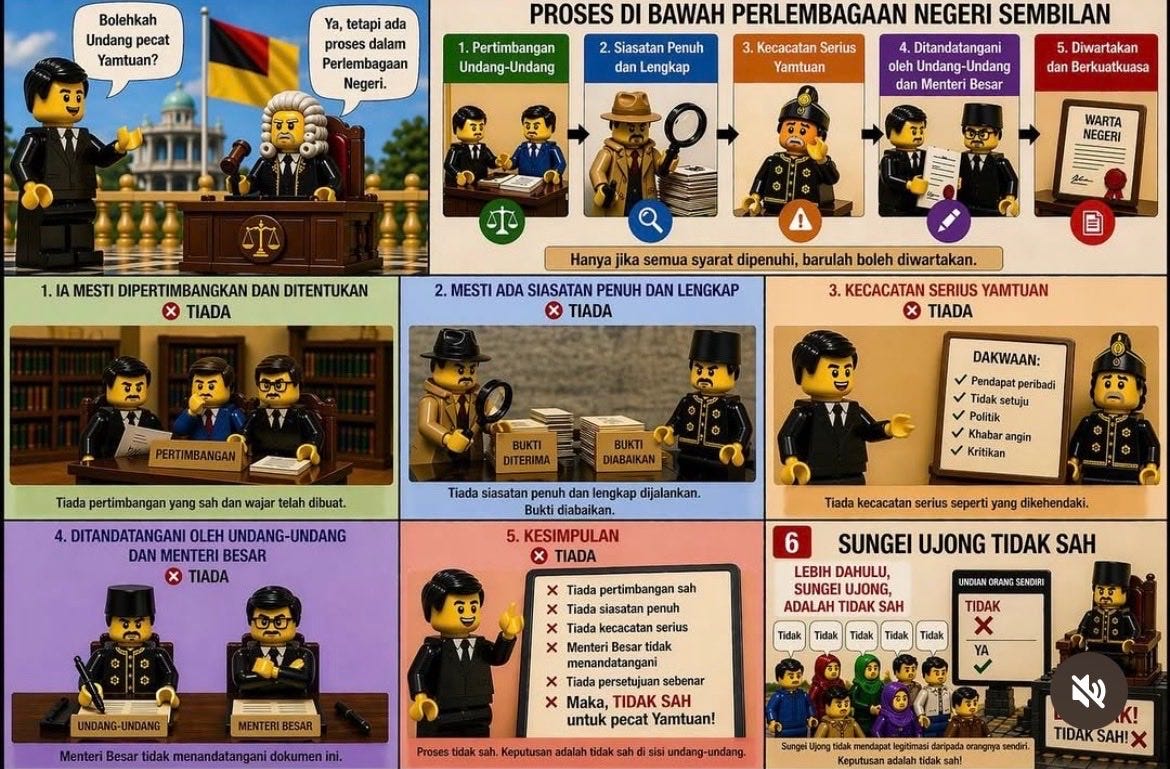
(Source: https://www.instagram.com/satriawiran9/)
There is a side to all of this that academics and brand analysts have been complaining about for years. Until early 2023, the free standard Twitter API let any developer pull around 18,000 tweets per day, and the dedicated Academic Research tier gave qualified researchers up to 10 million tweets per month with full-archive search going back to 2006, enough to make longitudinal sentiment analysis on Malaysian political discourse a genuinely tractable research project.
After Elon Musk's takeover, both were dismantled within weeks. Enterprise-level access today starts at around USD $42,000 a month, which puts archival sentiment analysis of a crisis like this one out of reach for most.
What makes the Negeri Sembilan moment particularly difficult to study is that a large share of the discourse, especially the Bahasa Melayu commentary, has migrated to Threads. The shift to Threads has created a methodological problem for anyone trying to study this crisis at scale. Meta's Threads API permits only 500 keyword searches per rolling seven days, and meaningful research access runs through the Meta Content Library, which is restricted to vetted academics and non-profits and not available to journalists or for-profit newsrooms.
Combined with the absence of in-app translation, this means the Bahasa Melayu commentary on Threads, where much of the most pointed discourse now sits, is harder to study systematically than Malaysian political discourse has been at any point in the last fifteen years.
A crisis unfolding in real time on social media is, paradoxically, harder for non-Malay speaking observers to follow than at any point in the last fifteen years.
How did TikTok contribute?
TikTok played a different but equally important role. While Twitter skewed toward analysis and debate, TikTok became the platform for creative content. These included AI-generated Lego videos of the DUN assembly with empty seats labelled “Pengabaian Tugas” (Neglect of Duty), satirical animations and explainer videos narrated in Nogori dialect.
Accounts like @waghihghombau.expose built significant followings almost overnight by combining Adat knowledge with sharp political commentary.
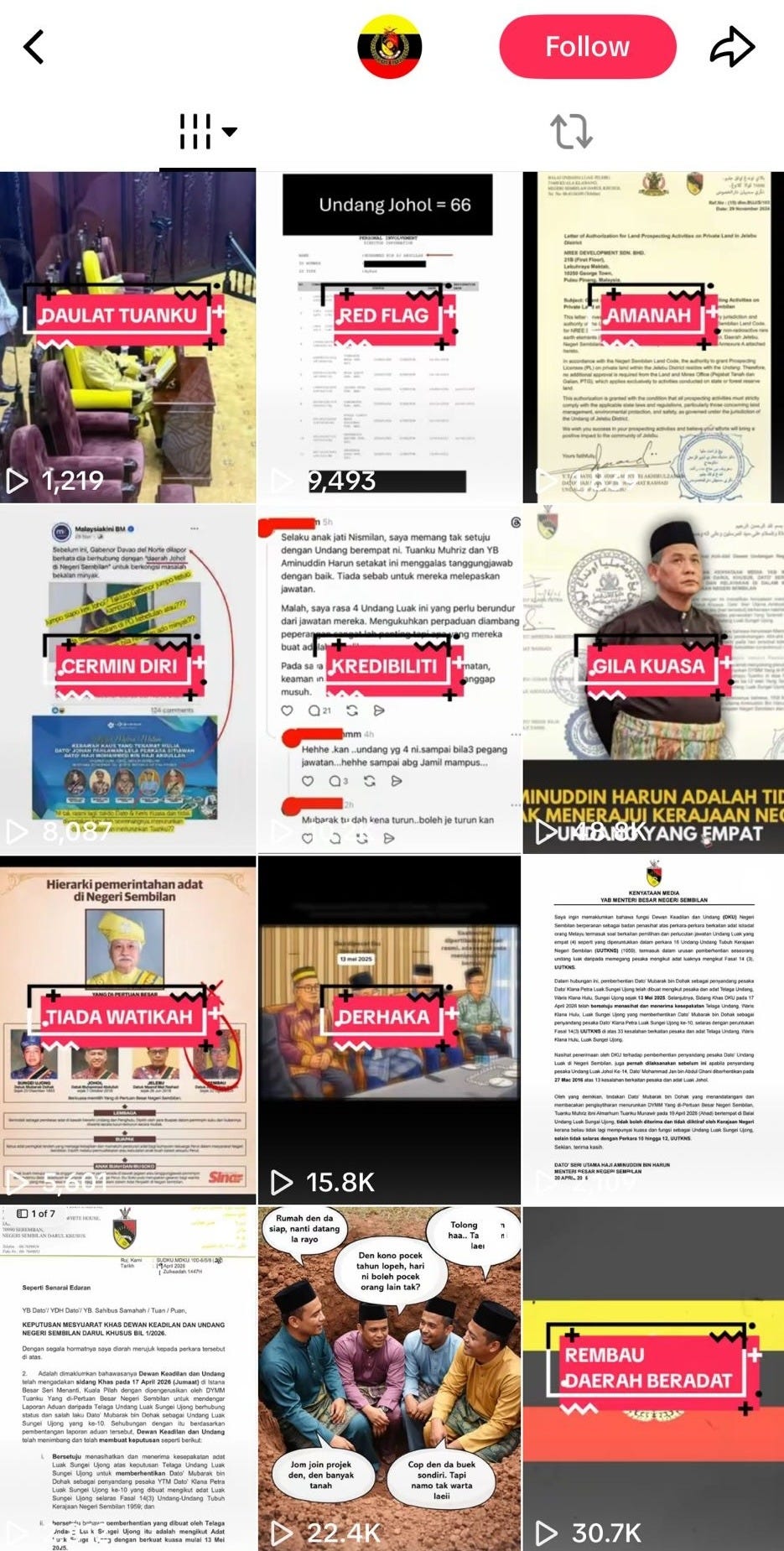
Other accounts have used TikTok as an awareness-building channel for important corporate documents. SSM records, company filings and the Balai Undang letterhead authorising rare earth mining rights, the kind of corporate paperwork usually circulates only among journalists, lawyers or activists, have surfaced on TikTok in the form of slide-by-slide breakdowns and narrated explainers.
Allegations of corruption against the Undang of Jelebu, centred on his role in granting mining rights to a company he later became a shareholder of before quietly exiting a month before the crisis, and against the Undang of Johol, whose 70 company directorships include mining firms and a rare earth company, have been laid out in detail by accounts that combine document screenshots with commentary in Nogori dialect.
The format makes complex corporate ownership trails legible to audiences who would never read an SSM extract, and it does so in a register that is closer to neighbourhood gossip than investigative journalism. None of these allegations have been formally tested in court, and the publication has not independently verified every document in circulation, but their reach on TikTok is now substantial.
TikTok reels and Lego-style infographics have brought the constitutional questions raised by the crisis to audiences that constitutional law articles rarely reach.
What role did WhatsApp play?
WhatsApp was where the crisis became truly national. The NREE Holdings SSM documents, the Balai Undang authorisation letter for rare earth mining, the 33 charges against Mubarak, the infographics on the Ibu Soko’s role, all circulated primarily through WhatsApp groups before they appeared anywhere in mainstream media.
This created a two-tier information ecosystem. Malaysians active in WhatsApp groups received detailed, document-heavy information about the crisis within hours of it becoming public. Mainstream media, given the 3R (Race, Religion, Royalty) sensitivities, was significantly more cautious and less detailed.
Some of the most pointed commentary on the crisis travelled this way too. A series of four essays written under the pen name Anak Negeri began circulating through WhatsApp forwards in early May in both English and Bahasa Melayu. Each piece addressed a different facet of the crisis: the Ibu Soko as the source of Adat legitimacy, the intellectual erosion of the chieftaincies, clan integrity, and the illusion of co-rule. This publication reproduced two essays in English, and the series was subsequently published on Free Malaysia Today's opinion pages between 3 and 15 May, moving from dark traffic into the mainstream record.
How did mainstream media cover the crisis?
Mainstream media faced a difficult balancing act. The 3R rule, which requires extreme caution, created significant constraints on how far journalists could go.
Most mainstream outlets reported the facts, the declaration, the MB’s rejection, the legal opinions, but stopped well short of the kind of investigative reporting the crisis warranted. The NREE Holdings story, for instance, was widely circulated on social media but received almost no mainstream coverage. The question of why the Undang declined to name any specific misconduct was raised but rarely pressed.
Social media, operating outside these constraints, filled the gap. This is not without risk. Claims about the Ja’afar family’s lifestyle circulated alongside genuine constitutional analysis, and it was often left to individual readers to distinguish between them.
What does this tell us about information in a royal crisis?
The 2026 Negeri Sembilan crisis reveals several important truths about how information flows in the social media age:
Speed has changed everything. By the time official responses were formulated, public opinion had already formed. The Undang’s failure to name specific misconduct for Tuanku Muhriz, which in a pre-social media era might have gone unnoticed or unreported, became immediately apparent to millions of people who watched the Facebook Live and asked the obvious question: what exactly did he do wrong?
Expertise is democratised. Constitutional law, Adat knowledge and legal analysis that would previously have been confined to law firms, universities and government offices became publicly accessible through social media threads and TikTok videos. Anyone with no legal training could, within 24 hours of the declaration, understand exactly why it was constitutionally invalid.
Satire is a serious tool. The memes, wordplay and Lego infographics that proliferated around this crisis were not just entertainment. They distilled complex constitutional arguments into accessible, shareable formats that reached audiences far beyond those who would read a legal opinion. #UndangDiSebalikBatu communicated a sophisticated argument, that the Undang had hidden motives, in three words and a rock emoji.
The 3R constraint is weakening. Social media has created space for Malaysians to discuss royal matters with a frankness that would have been unthinkable in previous generations. This is not necessarily disrespectful. Much of the most viral content was firmly pro-Muhriz in tone, and much of it framed in very respectful terms towards to royal institution. But the days when a constitutional crisis involving a state ruler could be managed through carefully worded official statements and compliant mainstream media appear to be over.
What are the risks?
The democratisation of information around this crisis has not been without costs.
Claims about the private lives of members of the Ja’afar family spread rapidly, with little ability for those targeted to respond. The line between legitimate public interest reporting and intrusive personal attack was frequently blurred.
The speed of social media also meant that nuance was often lost. The legal picture is genuinely complex. Former Menteri Besar Rais Yatim’s argument that the Undang do have a legitimate constitutional power is not frivolous, even if the majority of legal opinion disagrees with him. Social media tends to flatten such complexity into binary narratives.
And the risk of manipulation is real. In an information war of this intensity, both sides have motivation to plant stories, amplify favourable narratives and suppress unfavourable ones. Documents can be forged. Screenshots can be taken out of context.
What is the legacy?
Whatever the ultimate resolution of the Negeri Sembilan royal crisis, it has already changed something permanent about how Malaysians engage with their constitutional system.
Millions of people who had never heard of Adat Perpatih, the Ibu Soko, or Article 10 of the Negeri Sembilan Constitution 1959 now have at least a basic understanding of how power works in the state. The phrase gilo koso (power mad) has entered the national conversation as shorthand for the abuse of traditional authority. The hashtag #UndangDiSebalikBatu has given Malaysians a shared vocabulary for describing self-interested manipulation dressed up as tradition.
The Undang chose Facebook Live as their medium. But a Facebook Live is not a constitutional instrument. It cannot substitute for a valid proclamation, for the signature of the Menteri Besar, for gazettal, or for the naming of specific offences under Article 10 of the Negeri Sembilan Constitution 1959. It cannot confer authority on a signatory who had already ceased to hold office under the custom of the Luak. It cannot bypass the Dewan Keadilan dan Undang (DKU), whose acknowledgements Article 16(3) makes final.
The Facebook livestream attempted to be a substitute for proper processes, and for a legitimacy that a social media platform cannot confer. That may prove to be the more lasting lesson of this crisis: constitutional authority is conferred by process, not by livestream.
Read Next: Mirror, Mirror on the Wall: Reflections on Custom and Clans’ Integrity - By Anak Negeri
If you are new to this Substack and are not sure where to begin, visit our Start Here page, where we list all our articles organised by theme.
Related Posts:


Sources:
Anak Nogori is independent commentary on the unfolding constitutional crisis in Negeri Sembilan, where centuries-old Adat Perpatih, royal succession law, and modern political manoeuvring are colliding in ways Malaysia has never seen before. If you find this useful, share it with someone who should be following this, or subscribe to receive the latest articles in your inbox.
